Tag Archives: Recovery

Ambivalence about alcohol and HAMS

I am in a stage of ambivalence about drinking. I don’t know if I want to be 100% sober, but I don’t want to have the negatives from alcohol.

I did a cost benefit analysis, but still am unsure.

Health-wise, mental stability-wise, employment-wise I should at least only drink in moderation.

The main things I enjoy about alcohol: the way I feel, not as inhibited, something to do when bored and reduces my anxiety.

The things I don’t like are: getting sick, hangovers, health effects (mental and physical)

I went to a SMART Recovery meeting not long ago. If you don’t know what that is, it is on-line and in- person support for problem drinking. It is different from AA in many ways, but it is a sobriety program. At the end of the meeting I picked up brochures. One was on another support organization called HAMS. (Harm reduction, Abstinence, and Moderation support.)

There are very few online HAMS meetings, but they have a website with information and a forum. Members call themselves HAMSters. They don’t have steps but they have elements. They are suggestions on how to proceed but you don’t need to do them in order or do all. The first element was to make a cost benefit, pros/cons of using and pros/cons of not using. I have done them before, but did it again. I carry it around with me in case I forget why I want to drink less (or not at all).

The next element is to make a plan. Mine keeps evolving. I don’t drink and drive, which I want to continue. This was not an issue in the past, but I went to some meetup group meetings that included alcohol. So, if I go to those, I need to get a ride or stay sober. I know I want to reduce the amount I drink to a level where I won’t get a hangover. I was drinking a glass that held about 3 shots, which I have reduced to 2 and stick with one glass.

I can find things to do, other than drinking when bored, but I have to find a better way to deal with strong emotions. People around me have a bad day and get irritable. Then I react by becoming an anxious mess and drink to deal with the feeling. Or, I go to one of those meetups and get so nervous. Or, I had a long day and want to unwind.

So, here I am trying to decide what I want to do.
Mental Health Conference

i went to a conference today. There were 32 workshops..

the first i went to was on Borderline Personality Disorder. It was very informative and i learned a lot.  The next was on support groups, that was good. There were a number of organizations represented.

the last one i went to was “ask the doctors” on schizophrenia. It was an open forum for people to comment, and ask questions. There were suggested questions on the screen.

one of the questions was, “what has worked for you?”  I would have loved to hear the answers to that one.

one thing that worked for me, was talking to people with similar experiences, either on-line or in person. I went to dbsa support groups, nami connections and eventually started a group affiliated with the national organization, schizophrenia alliance. I don’t run the group anymore, but i am glad it is still going.

another thing, that is a little different, was when i was very troubled with auditory hallucinations, my psychiatrist found a way to communicate. He wrote words while he spoke, circling and crossing out important words.

no, one had asked what my experience was like when i had a psychotic break. They asked about symptoms, but not what were the voices saying or what the messages were. Not until i saw a therapist who seemed interested. It felt lke a relief to be able to tell my story.

i would love if anyone would share what has helped them


Stages of Change in Recovery From Alcohol Addiction

Originally published in Psych Central

https://blogs.psychcentral.com/triple-winner/2017/04/stages-of-change-in-recovery-from-alcohol-addiction/

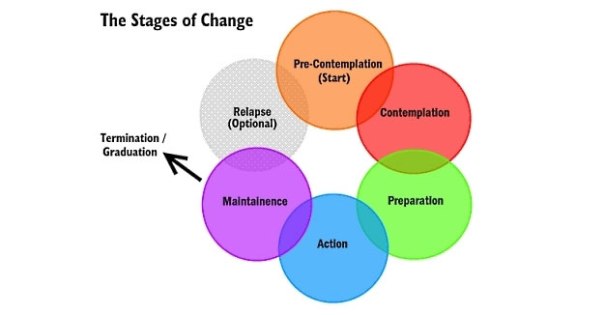
stages of change

(Photo from SmartRecovery.org)

There are a number of stages one goes through when recovering from an addictive behavior.

1. Pre-contemplation — at this stage one is unaware of any problems. Others may point them out, but you have no interest in changing.

2. Contemplation– At this stage one is aware of the problem, but not sure how to change. You may be thinking about changing but ambivalent.

3. Preparation– You develop a plan to change behavior.

4. Action– Modify behavior to put plan into action

5. Maintenance-Able to stick with new behavior with minimum effort and strong commitment

6. (Termination)– In some recovery programs they have a step where you have completed and no longer have the addictive behavior.

(Relapse)-relapse may happen at any time. It is common, but not everyone has a relapse. A relapse is when you revert to the addictive behaviorI was in the pre-contemplation stage with my drinking for years. If people would suggest I had a problem, I thought it was their problem. I started having certain rules. I wouldn’t drink if I had to drive or if I had responsibilities.

When I contemplated changing, I was ambivalent. Not sure I wanted to abstain forever. Not sure it was a problem. I prepared and even started going into action and would stop drinking for a bit, but then I would relapsebecause I had not really made the decision to quit.

I had done cost/benefits (pros/cons) and knew it was beneficial to quit. I knew drinking wasn’t one of my priorities. I knew I would drink more than I wanted to and had trouble abstaining. But, there was a part of me that still said “you’ll miss out on the fun”. And, I may. I will also miss out on any consequences.

I am in active recovery right now. I have been going to meetings and sticking with a plan. I have worked on motivation and controlling urges. I am using cognitive behavioral therapy and other techniques to control my distorted thinking.

I can resist temptations. I have been sober for 5 months straight. Another month of consistency and I believe I will be in the maintenance stage. At my work, they are training a couple of people, including me, to facilitate a SMART Recovery group. Facilitating should help keep me focused.

The end goal of these stages, is to live a life that is complete without alcohol.

Finding Support for Mental Illness and Alcoholism

beachvacation


Originally published on Psych Central
https://blogs.psychcentral.com/triple-winner/2017/03/finding-support-for-mental-illness-and-alcoholism/

It can be hard dealing with a mental illness and/or alcoholism without support from a loved one. Perhaps, they don’t recognize it as a real problem. They may be frightened or not comprehend what is happening. Sometimes, partners may even try to sabotage your recovery.

There could be any number of reasons why you could use some outside help.

Friends and family can be of assistance, but oftentimes they don’t understand.

One way of getting help is to go to support groups. There are national organizations for many types of mental illnesses, addictions or co-occurring disorders. AA has sponsors (I have never had one). You can also make friends and have someone to contact if you are having a rough time.

There is something about peer support, and being with others who have been there, that is special. I remember the first time I went to a (DBSA), Depression and Bipolar Support Alliance, meeting. I was frustrated because I couldn’t find anything that sounded like me in the textbooks. Then, I met people I could relate to at the meeting. I had found “my people”. Now, I choose to work as a peer mentor because I believe in the power of peer support.

Professional help is good, too, though, not as readily available. I call my therapist when I am not doing well mentally.

You can turn to the internet. There are all types of message boards and chat rooms where you can go for support. You can meet people from all over the world to share experiences with.

Social media is a way of meeting people and blogging is a way to be heard.

They aren’t very common, but there are clubhouses or activity centers for people with mental illnesses. I work at one such center. We have all kinds of activities: gardening, art, music and a lot of different groups. It is a nice place to meet others and be supported.

Volunteering and helping others can help you, too. It can be rewarding and if you work with people with similar issues you may learn new resources or coping skills.

The main source of support you will find is within yourself. You will be the one to resist temptations and cravings. You will be the one to act on warning signs and develop coping skills.

When you are on your way in recovery, you may find you are stronger than you know.

Photo courtesy Max Pixel
http://maxpixel.freegreatpicture.com/Nature-Ocean-Beach-Thinking-Pensive-Waves-1927359

The Stigma of Co-Occurring Disorders

In my opinion, this is my best yet 🙂

Originally published on Psych Central
https://blogs.psychcentral.com/triple-winner/2017/03/the-stigma-of-co-occurring-disorders/

There is a great deal of stigma attached with both mental illnesses and addictions. That is one reason I talk about my experiences. So, others won’t feel alone, and, to put a face to these conditions. It is scary to get a diagnosis of a life-long mental health condition that all you have heard are extreme negatives. People can lose hope. And, people fear what they don’t know.

I also have shame, or self-stigma. I have worked on accepting the schizoaffective diagnosis and at this point am okay. There was a time when I felt, less than, because of the severe symptoms. Now, I know I could not control what happened in the past, and just work on staying stable.

Social anxiety is something I contend with daily, and I cannot seem to prepare enough. I don’t know if I can ever accept how limiting it is for me. There are some things, like volunteering at my children’s school events, that are just too busy for me. I cannot enjoy shopping or parties, I just want an exit. I have worked very hard on this and work with people now and even do public speaking, but it is difficult.

The alcohol addiction label is new to me. In the program I am doing, SMART Recovery, they don’t give labels. But, I need to call it something. The drinking is not new, just the acknowledgement.

There are choices of programs for changing addictive behaviors. Some people work more than one at a time. This was just one that seems to fit my philosophy. It uses cognitive behavioral therapy (CBT) principles and I already learned some of those for my anxiety.

I haven’t had serious consequences from drinking. No DUIs or jail time, No relationship problems. But, I drink more than I would like to and it is hard for me to abstain completely.

When I started this blog, I decided I would like to write about the alcohol component along with the mental illness. So many of us have co-occurring disorders. I was excited, and then, I paused. What will people I know think when they see ‘alcoholic’?

Then I giggled. First, because I can’t decide which is the lesser of 2 stigmas (it doesn’t matter). And then, because they all have seen me drink. It isn’t really a surprise.

The secret is that I am working on it.

Info on SMART Recovery
http://www.smartrecovery.org/

Info on Alcoholics Anonymous (AA)
http://www.aa.org/

Someone Has A Sense of Humor

I have attended a few Alcoholics Anonymous (AA) meetings. They are supposed to be more of a spiritual, than a religious program. I never felt like I belonged at the few meetings I went to. It also felt more religious than I am comfortable with, from the higher power, to the Serenity Prayer.

I looked around for alternatives and found SMART recovery which is cognitive behavioral therapy oriented. Many people do both AA and SMART together, but for me it is a good secular alternative. I have been attending meetings in-person and on-line since September. I have found a meeting where I feel I belong. I have learned a number of tools already and there are still more.

I work as a peer mentor and am excited about this program and have approval to bring it to my work 😀

I have a different group that is at a bad time, when the center is slow, that almost no one comes to. I was told to find something new. I found an organization called schizophrenia alliance and asked for materials. When they arrived, I found they were formally Schizophrenia Anonymous and it is a 6 step program, based on the 12 steps of (AA). It looks like something our members will enjoy snd I will run it.

I feel awkward. Why me of all people? I know about schizophrenia, and recovery, but not about this program.

My co-worker is going to help me prepare and I have all the material.

Who knows, maybe I will learn to appreciate step programs more.